NYSCEF is the New York State Courts Electronic Filing system used for submitting and reviewing court documents through an online platform. The nyscef system supports the New York State Unified Court System by replacing traditional paper filing with a structured digital process. Attorneys, court staff, and registered case parties file pleadings, motions, and other legal forms directly through the platform. The system keeps electronic court filing organized within the court docket. Each case record stays stored in one secure digital location. This structure helps courts manage filings more efficiently across many New York civil courts.
NYSCEF NY plays a central role in managing digital court records across the state’s judiciary network. The nyscef system allows users to submit documents, review case filings, and track court activity without visiting the courthouse. Judges and clerks review submitted files within the platform. Law firms rely on it to manage case paperwork and deadlines. This online filing structure improves transparency in the NY judiciary system. Digital case management supports faster record handling and better organization of court documents.

NYSCEF Filing Help for Self-Represented Parties
People can complete NYSCEF filing without an attorney. The New York court system allows self-represented litigants to submit legal documents online through the NYSCEF system or other approved electronic services.
Anyone managing their own case can review the Unrepresented Litigants information page provided by the New York State Unified Court System. This page explains how to prepare documents, file them online, and follow case activity within NYSCEF courts.
Naked URL for reference:
https://iapps.courts.state.ny.us/nyscef/UnrepresentedLitigants
Sending Court Documents with EDDS
The Electronic Document Delivery System (EDDS) works as an online court portal that allows people to send documents to courts that do not yet support full electronic filing. It is helpful when a case is not active in the new york nyscef system.
Through EDDS, users can submit documents such as:
- Stipulation of Consent
- Letter Application
- Other forms used for legal document filing
These documents help the court process requests and may allow a case to move into the NYSCEF system.
Users can submit documents through EDDS at this page:
https://iappscontent.courts.state.ny.us/NYSCEF/live/edds.htm
Important Filing Note
If a Stipulation & Consent is related to a case in the following Supreme Courts, it must be filed directly through NYSCEF, not EDDS:
- Bronx Supreme Court
- Nassau Supreme Court
- New York Supreme Court
- Orleans Supreme Court
- Queens Supreme Court
Direct electronic filing helps the courts maintain accurate digital case records within the official court document management system.
NYSCEF filing portal (naked URL):
https://iapps.courts.state.ny.us/nyscef/HomePage
Emergency Court Applications
Emergency applications for Supreme Court civil cases outside normal court hours require direct contact with court services.
People facing urgent legal situations can contact the emergency court line:
- Phone: (800) 430-8457
- Email: emergency@nycourts.gov
This service supports urgent filings when the courthouse is closed.
Free NYSCEF Training Classes
The New York courts provide free NYSCEF training classes for attorneys and self-represented litigants. These sessions explain how to use the electronic filing system, submit documents, and manage digital case records.
Some classes may include CLE (Continuing Legal Education) credits.
Upcoming Training Sessions
| Court | Date | Time |
|---|---|---|
| Surrogate Court | February 6, 2025 | 10:00 AM – 12:00 PM |
| Supreme Court | February 5, 2025 | 10:30 AM – 12:30 PM |
| Family Court | February 19, 2025 | 10:00 AM – 12:00 PM |
More training information is available here:
https://iappscontent.courts.state.ny.us/NYSCEF/training
NY E-Filing Login
The NY e-filing login page lets users access the NYSCEF system to submit legal documents, track cases, and view digital case records. This portal supports attorneys, court staff, and self-represented litigants in managing filings in participating NYSCEF courts.
You can log in here:
https://iapps.courts.state.ny.us/nyscef/HomePage
Courts Available in the NY E-Filing System
The NYSCEF system supports filing or document viewing for several court types. Availability depends on the court and case category.
| Court Type | NYSCEF Availability | Naked URL |
|---|---|---|
| Appellate Court | Electronic filing available | https://iapps.courts.state.ny.us/nyscef/AppellateCourt |
| Court of Claims | E-filing supported | https://iapps.courts.state.ny.us/nyscef/CourtOfClaims |
| Criminal Court | Limited availability | https://iapps.courts.state.ny.us/nyscef/CriminalCourt |
| EDDS Court Processing | Document submission via EDDS | https://iapps.courts.state.ny.us/nyscef/EDDS |
| Court Use Only | Internal court processing | https://iapps.courts.state.ny.us/nyscef/CourtUseOnly |
| Family Court | Available in select counties | https://iapps.courts.state.ny.us/nyscef/FamilyCourt |
| NYC Civil Court | E-filing supported | https://iapps.courts.state.ny.us/nyscef/NYCCivilCourt |
| Supreme Civil Court | Fully supported | https://iapps.courts.state.ny.us/nyscef/SupremeCivilCourt |
| Surrogate Court | Estate filings available | https://iapps.courts.state.ny.us/nyscef/SurrogateCourt |
| Town / Village Court | Limited availability | https://iapps.courts.state.ny.us/nyscef/TownVillageCourt |
Note: Some courts allow document viewing only. Filing features may be limited depending on case type and county.
What You Can Do After NYSCEF Login
Once logged in to the online court portal, users can:
- Submit documents electronically
- View digital case records and past filings
- Track case activity and deadlines
- Download filed legal documents
- Manage court document management efficiently
The NYSCEF system streamlines court processes, reduces paper filings, and gives authorized users secure access to case records from anywhere.
NYSCEF Live and Training Systems
The NYSCEF system has two separate platforms: a Live system for real cases and a Training system for practice. Each system requires its own registration, meaning you must create a unique username and password for each.
- Live System: Used for actual case filings in participating NYSCEF courts.
- Training System: Allows attorneys, court staff, and self-represented litigants to practice filing and managing digital case records without affecting real cases.
To create an account for either system, users must complete the registration form and verify their credentials. Each account is independent, so logging into one system does not grant access to the other.
Create your NYSCEF account here:
- Live System: https://iapps.courts.state.ny.us/nyscef/HomePage
- Training System: https://iapps.courts.state.ny.us/nyscef/Training
Important NYSCEF Links
The New York State Courts Electronic Filing (NYSCEF) system provides easy access to filing, case tracking, and resources for both attorneys and self-represented litigants. Below is a list of the most useful links for navigating the NYSCEF platform:
| Title | Description | Naked URL |
|---|---|---|
| NYSCEF Login Page | Official login portal for e-filing in civil, Supreme, and surrogate courts. | https://iapps.courts.state.ny.us/nyscef/HomePage |
| NYSCEF Home Page | Main page with news, updates, and access to all NYSCEF functions. | https://iapps.courts.state.ny.us/nyscef/HomePage |
| Case Search (Find Case Info) | Search for public case documents and docket information in NYSCEF. | https://iapps.courts.state.ny.us/webcivil/FCASMain |
| E-Filing County List | See which counties and courts currently allow e-filing via NYSCEF. | https://iapps.courts.state.ny.us/nyscef/countyList |
| Frequently Asked Questions (FAQs) | Official FAQ page for users of NYSCEF. | https://iapps.courts.state.ny.us/nyscef/FAQ |
| NYSCEF Forms Library | Forms required for electronic filings across various court types. | https://iapps.courts.state.ny.us/nyscef/forms |
| Attorney Registration for NYSCEF | For attorneys to register for the NYSCEF e-filing system. | https://iapps.courts.state.ny.us/nyscef/attorneyReg |
| Unrepresented Litigants E-Filing Info | Guide for self-represented (pro se) litigants using NYSCEF. | https://iapps.courts.state.ny.us/nyscef/UnrepresentedLitigants |
| NYSCEF Resource Center Contact | Phone and email support for NYSCEF-related questions. | https://iapps.courts.state.ny.us/nyscef/contact |
| Training Videos & Tutorials | Official video guides on how to use the NYSCEF system. | https://iapps.courts.state.ny.us/nyscef/training |
Before electronic filing, courtrooms were filled with towering stacks of paper, and legal professionals often spent hours locating and organizing documents manually. Today, NYSCEF allows for secure digital case records, faster filings, and easier access for attorneys, judges, and self-represented litigants.
Other key tools and portals linked with NYSCEF include:
- WebCrims: Criminal case management portal – https://iapps.courts.state.ny.us/webcrims
- EDDS: Electronic Document Delivery System for courts not fully on NYSCEF – https://iapps.courts.state.ny.us/nyscef/EDDS
- eCourts NY: Case information and docket search – https://iapps.courts.state.ny.us/webcivil/FCASMain
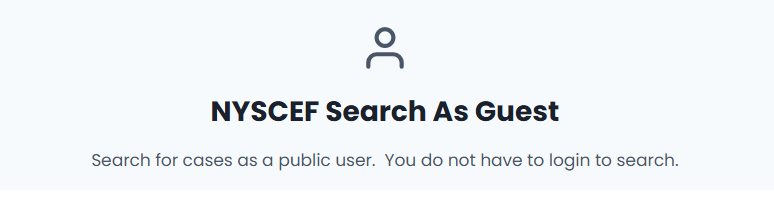
What Is NYSCEF Case Search?
The NYSCEF Case Search is a tool within the New York State Courts Electronic Filing system that allows users to find and view court cases and documents online. It helps attorneys, self-represented litigants, and researchers access digital court records without visiting the courthouse.
This search feature is part of the NYSCEF system, which has transformed how legal documents are filed and managed in New York courts. By moving away from paper filing, the system makes the legal process more efficient, transparent, and accessible. Users can quickly locate case information, view filings, and track court document management tasks online.
Main Goals of NYSCEF Case Search
- Efficiency: Accelerates submission and processing of court documents.
- Accessibility: Provides easy online access to case information for all parties.
- Transparency: Makes court records publicly available, enhancing trust in the legal process.
- Cost-effectiveness: Reduces expenses for paper filing, printing, and storage.
- Collaboration: Improves communication among attorneys, courts, and litigants.
The NYSCEF Case Search page is available here:
https://iapps.courts.state.ny.us/webcivil/FCASMain
History of New York Electronic Filing (NYSCEF)
The New York State Courts Electronic Filing (NYSCEF) system began in the early 2000s with pilot programs in a few select courts. These early trials tested the potential of electronic filing to improve court efficiency and reduce reliance on paper documents.
As the benefits became clear, the New York State Unified Court System gradually expanded NYSCEF to more courts and case types. Over the years, the system incorporated user feedback and adapted to new technologies, making it more reliable, secure, and user-friendly.
Key milestones in NYSCEF’s development:
- Early 2000s: Pilot programs launched in select courts to test electronic filing.
- Mid-2000s: Expansion to additional civil and Supreme courts, increasing access for attorneys.
- 2010s: Integration of more case types, improvements in court document management, and introduction of training resources.
- Present: NYSCEF is widely used across many NYSCEF courts, supporting both attorneys and self-represented litigants.
Although availability varies depending on court and case type, NYSCEF continues to grow. Ongoing updates focus on expanding its functions, improving usability, and ensuring secure access to digital court records.
Benefits of New York Electronic Filing (NYSCEF)
The New York State Courts Electronic Filing (NYSCEF) system offers many advantages compared to traditional paper filing, making the legal process faster, more efficient, and more accessible.
Key Benefits of NYSCEF
- Increased Efficiency and Speed
Filing documents electronically eliminates long lines at the courthouse and reduces reliance on mail. Documents are submitted instantly, and processing times are much faster, helping both attorneys and court staff save valuable time. - Reduced Paperwork and Storage
E-filing in New York minimizes the need for physical documents, saving storage space and reducing environmental impact. Digital records also simplify court document management and make retrieval quick and reliable. - Improved Access to Court Documents
Authorized users can view digital court records anytime, from anywhere with an internet connection. This 24/7 access removes the need to visit the courthouse to review case files. - Enhanced Collaboration
Electronic filing allows easier sharing of documents among all authorized parties. This improves communication, speeds up case management, and streamlines the exchange of information. - Cost Savings
Reducing paper usage and storage needs helps courts and legal professionals cut costs. Administrative expenses decrease, making the judicial process more cost-effective. - Transparency
Making court records easily accessible promotes transparency in the judicial system. The public can better understand court proceedings and monitor case progress, fostering trust in the legal process.
NYSCEF Search vs. Traditional Paper Filing
The difference between NYSCEF search and traditional paper filing is significant. Paper filing requires physically delivering documents to the courthouse, manually organizing files, and storing large volumes of paper. This process is time-consuming, prone to errors, and often inefficient.
Retrieving paper documents can be slow, especially for older cases or heavily used files. In contrast, e-filing in New York provides instant access to digital case records, streamlining the filing process and reducing administrative burdens.
Key Advantages of NYSCEF Over Paper Filing
- Instant Filing and Retrieval: Documents are submitted and accessible immediately, avoiding delays from mailing or in-person delivery.
- Reduced Risk of Loss: Digital records eliminate the chance of lost, damaged, or misfiled papers.
- Efficient Document Management: Courts and legal professionals can easily organize, search, and share files electronically.
- Remote Access: Authorized users can review case files anytime from any location with an internet connection.
- Enhanced Accuracy: Automated filing and indexing reduce human errors common in paper-based systems.
Overall, NYSCEF makes court operations faster, safer, and more accessible. It improves workflow for attorneys, courts, and self-represented litigants, making electronic filing a critical tool in modern legal practice.
Access NYSCEF Case Search here:
https://iapps.courts.state.ny.us/webcivil/FCASMain
How NYSCEF E-Filing Works
The NYSCEF system streamlines court procedures by enabling electronic filing and service of legal documents. It simplifies case management for attorneys, self-represented litigants, and court staff while providing secure access to digital court records.
Registration
Before using NYSCEF, users must create an account. Each user receives a unique username and password, separate for the Live system and the Training system.
Who Needs to Register?
- Attorneys:
All attorneys practicing in New York courts that allow e-filing are generally required to register. Registration ensures they can submit filings, track case activity, and receive notifications electronically. - Self-Represented Litigants:
Individuals representing themselves can also register. While not always mandatory, registering is highly beneficial for managing filings, accessing case documents, and staying updated on case progress.
Register for NYSCEF here:
Live System: https://iapps.courts.state.ny.us/nyscef/HomePage
Training System: https://iapps.courts.state.ny.us/nyscef/Training
Instructions on Creating a NYSCEF Account
The NYSCEF system offers two separate platforms:
- Live System: For actual court case filings.
- Training System: For practice, learning, and testing filings.
Each system requires its own account with a unique username and password.
For Attorneys
Attorneys practicing in New York courts must register to use NYSCEF. Follow these steps:
- Go to the official NYSCEF Attorney Registration page:
https://iapps.courts.state.ny.us/nyscef/attorneyReg - Select “Attorney Admitted”.
- Enter your Attorney Registration Number (find it in the NY Attorney Directory).
- Fill out required information, including your name, contact details, bar number, and other relevant details.
- Review and accept the terms and conditions of use.
- Submit the registration form.
- Check your email for activation instructions and follow them to complete your account setup.
For Self-Represented Litigants
Individuals representing themselves without an attorney can register using the Unrepresented Litigants process:
- Visit the NYSCEF Unrepresented Litigants page:
https://iapps.courts.state.ny.us/nyscef/UnrepresentedLitigants - Choose whether your account is for new cases or existing cases.
- Accept the terms and conditions of use.
- Fill out required information, including name, contact details, mailing address, and email.
- Submit the registration form.
- Follow the activation instructions sent via email to complete your account setup.
Common Registration Issues
- Password Problems: Use the password recovery option on the NYSCEF website if you forget your password.
- Technical Difficulties: Contact the NYSCEF Resource Center for assistance:
https://iapps.courts.state.ny.us/nyscef/contact - Account Activation Issues: Check your spam/junk folder for activation emails or reach out to NYSCEF support if you don’t receive the email.
Instructions for E-Filing on NYSCEF
Filing documents through NYSCEF simplifies court procedures by letting attorneys and self-represented litigants submit documents electronically. Here’s a clear, step-by-step guide:
File Format
- All documents uploaded to NYSCEF must be in PDF format.
- Ensure your PDF is complete, legible, and properly formatted before submission.
Registration
- Lawyers and self-represented litigants must create an account on the NYSCEF website before filing.
- Live System: https://iapps.courts.state.ny.us/nyscef/HomePage
- Training System: https://iapps.courts.state.ny.us/nyscef/Training
Filing Fee
- Standard electronic claims require a $50 filing fee, payable online via credit card or in person at the court clerk’s office.
- Filing motions to submit a late claim usually does not require a fee.
No Extra Paper Copies
- After e-filing, do not send paper copies to the court unless a judge specifically requests them.
- This reduces clutter and ensures the court works with the official digital record.
Serving the Defendant
- You must notify the defendant(s) about your lawsuit (called “service”).
- File proof of service electronically using an Affidavit of Service.
Notice of Electronic Filing
- For every claim filed, serve and file a “Court Notice Regarding Availability of Electronic Filing.”
- Complete this form, print it, and submit electronically—even if the claim number isn’t yet assigned.
Converting Existing Paper Claims
- To switch a paper-filed case to electronic filing, submit:
- The Court Notice Regarding Availability of Electronic Filing
- The Consent to E-Filing form
Working Copies
- If the court requests a paper copy of an electronically filed document, attach the Confirmation Notice received from NYSCEF when e-filing.
- This identifies the paper as a working copy of a previously submitted electronic document.
Original Paper Documents
- In rare situations, you may need to file an original paper document even in e-filed cases.
- Attach the “Notice of Hard Copy Submission – E-Filed Case” form to indicate the document’s status.
Hard Copy Exhibits
- If submitting paper exhibits (per Rule 202.5-b), file a “Notice of Hard Copy Exhibit Filing” through NYSCEF.
- This ensures the court acknowledges paper evidence while maintaining the electronic record.
NYSCEF E-Filing Process
Filing documents electronically through NYSCEF is simple and structured. Below are steps to help attorneys and self-represented litigants complete e-filing efficiently.
Steps E-Filing Process
- Log In
- Sign in to your NYSCEF account.
- Live System: https://iapps.courts.state.ny.us/nyscef/HomePage
- Training System: https://iapps.courts.state.ny.us/nyscef/Training
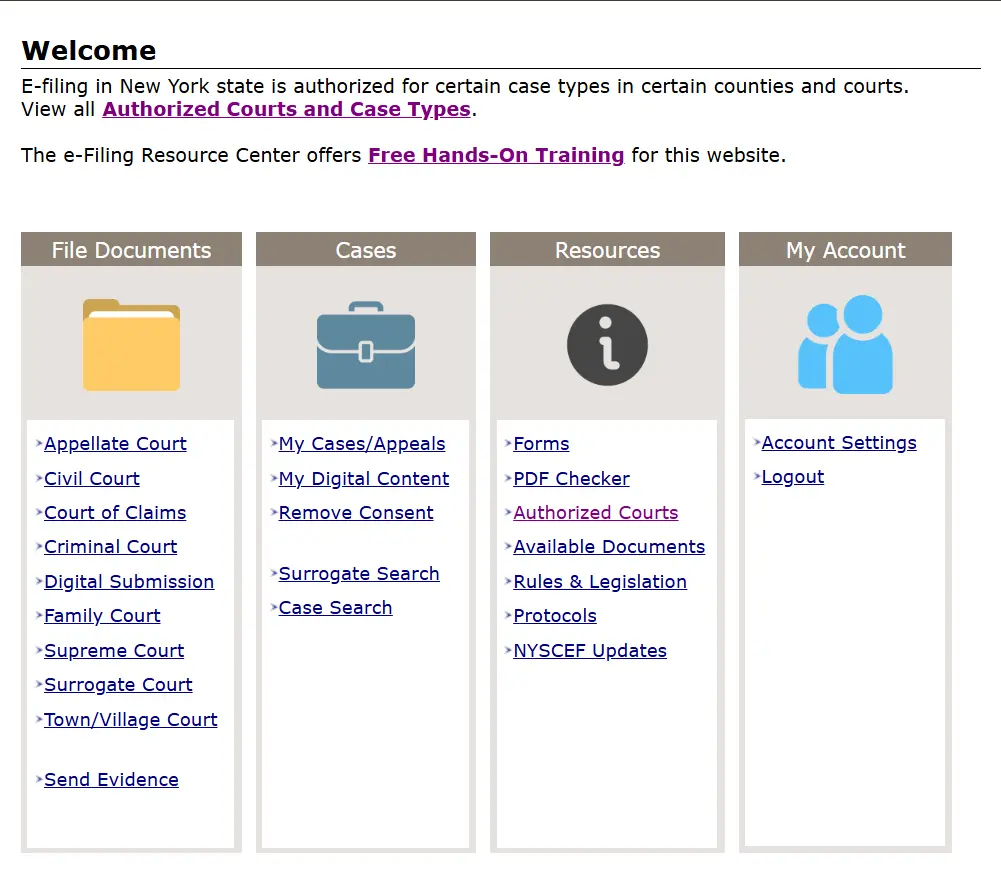
- Navigate to File Document Section
- Click on the “File Document” option in your dashboard.
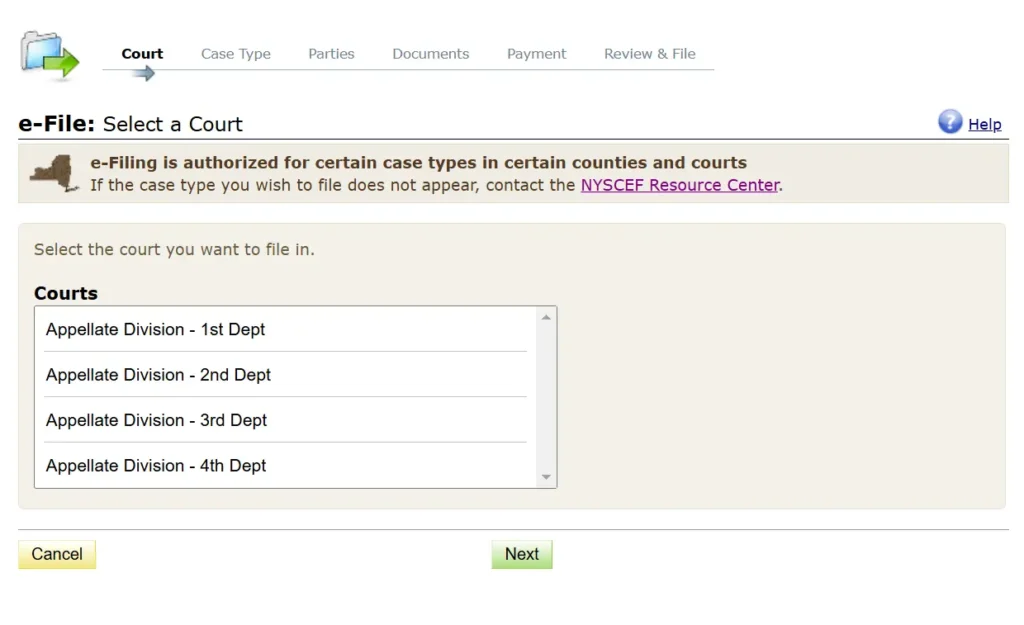
- Select Court and Case Type
- Choose the correct court where your case will be filed.
- Select the case type to ensure documents are submitted in the proper location.
Available Courts and Filing Options:
- Appellate Court
- Civil Court
- Court of Claims
- Criminal Court
- Digital Submission
- Family Court
- Supreme Court
- Surrogate Court
- Town/Village Court
- Send Evidence
- Input Party Information
- Enter the names of all parties involved in the case.
- Upload PDF Documents
- Only PDF format is accepted. Ensure all documents are complete and legible.
- Payment of Filing Fees
- If your filing requires a fee, you will be prompted to pay electronically, usually via credit card.
- Motions for late filings may not require a fee.
- Review and Submit
- Double-check all information and attached documents.
- Click Submit to complete the filing.
Tip: After submission, NYSCEF generates a Confirmation Notice. Save this as proof of filing and use it if a paper copy is requested by the court.
Electronic Service: Serving Documents Electronically
The NYSCEF system allows parties to serve legal documents electronically, making the process faster and more reliable than traditional paper service. Proper electronic service ensures all parties receive necessary filings and keeps the case moving efficiently.
How to Serve Documents Electronically
- Log In to NYSCEF
- Access your account: https://iapps.courts.state.ny.us/nyscef/HomePage
- Prepare Documents for Service
- Ensure all files are in PDF format.
- Select the documents you need to serve.
- Enter Recipient Information
- Input the email addresses of all parties who must receive the documents.
- Only authorized recipients registered in the NYSCEF system can receive electronic service.
- Follow E-Service Rules
- Familiarize yourself with NYSCEF e-service rules to ensure compliance.
- Certain documents may have special requirements, depending on case type and court rules.
Affidavit of Service
- After completing e-service, file an Affidavit of Service with the court.
- This affidavit confirms that documents were successfully served on all required parties electronically.
- Filing this affidavit is an important legal requirement to verify service.
Accessing Filed Documents: Retrieving Information
- Log In to your NYSCEF account.
- Use the Search function to locate the case.
- Browse the case file to find the specific documents you need.
Public vs. Restricted Access
- Some documents are public, while others are restricted based on court rules and the nature of the case.
- NYSCEF automatically enforces these access levels to protect sensitive information.
Downloading and Printing
- Authorized users can download and print documents directly from NYSCEF for personal records or submission.
- Always ensure you retain the Confirmation Notice when printing working copies of electronically filed documents.
NYSCEF for Different Court Types
The NYSCEF system is a versatile electronic filing platform, but its functionality and requirements vary by court and case type. Not all courts in New York currently support e-filing, so it’s important to check the official NYSCEF website for the latest list of authorized courts and case types.
Common Courts Using NYSCEF
- Supreme Court (Civil): Many civil cases in Supreme Court can be filed electronically.
- Court of Claims: Claims against the State of New York are often submitted via NYSCEF.
- Family Court: Some proceedings in Family Court are eligible for electronic filing.
- Surrogate’s Court: Certain estate and probate matters may be e-filed.
- County Court: Availability differs depending on the county.
- New York City Civil Court: Select case types are eligible for electronic filing.
Check the NYSCEF portal for the most up-to-date list of authorized courts:
https://iapps.courts.state.ny.us/nyscef/countyList
Specific Instructions and Requirements
Each court may have unique rules and procedures for e-filing:
- Document Formatting: Courts may specify margins, font size, and other formatting requirements.
- Filing Fees: Fee schedules vary depending on the court and case type.
- Required Forms: Some filings require specific NYSCEF forms.
- Deadlines: Electronic filing deadlines may differ from paper filing deadlines.
- Local Rules: Individual courts may have rules affecting submission and service.
Variations in the E-Filing Process
- Case Initiation: Steps to start a case electronically may differ by court.
- Document Types: Certain documents may be allowed in one court but not another.
- Service Requirements: Rules for serving documents electronically vary.
- Technical Requirements: File size limits, naming conventions, and other technical rules may differ.
NYSCEF E-Filing Training
The NYSCEF system provides training programs to help users learn how to file and manage court documents electronically. These programs support attorneys, court staff, and self-represented litigants who want to work with electronic court filing and digital case records more efficiently.
Training helps reduce mistakes, improves filing accuracy, and helps users work smoothly with the New York electronic filing platform. Participants learn how to submit documents, review case files, and complete common tasks in the system.
Official training resources:
https://iappscontent.courts.state.ny.us/NYSCEF/training
Types of NYSCEF Training Programs
The training programs usually include several learning formats so users can choose the method that fits their needs.
1. Online Webinars
- Interactive sessions held online
- Participants join from home or office
- Instructors explain system features and filing steps
- Real-time questions and answers are often included
2. In-Person Classes
- Classroom-style sessions with hands-on instruction
- Participants work directly with the NYSCEF platform
- Trainers demonstrate document filing and case management tools
3. Self-Paced Tutorials and Guides
- Video tutorials explaining filing procedures
- Step-by-step written manuals
- Training materials available anytime
These learning resources help users understand the electronic filing process, prepare documents correctly, and manage court document records within the NYSCEF system.
NY E-Filing Support Contact
Users who need assistance with the system can contact the NYSCEF Resource Center operated by the New York State Unified Court System.
Contact Details
- Phone: 646-386-3033
- Fax: 212-401-9146
- Email: nyscef@nycourts.gov
- Website: https://www.nycourts.gov/efile
Office Address
Office of Court Administration
Attn: E-Filing Resource Center
25 Beaver Street – 9th Floor
New York, NY 10004
Support Hours
- Monday to Friday
- 8:00 AM – 5:30 PM
NYSCEF and Other Court Systems
It interacts with other court systems, most notably:
- WebCrims: While it is for filing, WebCrims is primarily for viewing criminal case information. These systems are separate but complementary. You might file a document via it and then later check WebCrims to see if it has been processed and is publicly accessible.
- EDDS (Electronic Document Delivery System): EDDS serves a different purpose than NYSCEF. It’s used for sending documents to courts where e-filing isn’t available for that specific task, or for sending specific document types like Stipulations of Consent to E-Filing. It is the preferred method for e-filing when available.
Explain How These Systems Work Together:
These systems work independently but can be used in conjunction. For example, a lawyer might use New York Electronic filing to file a motion, WebCrims to check the status of the case, and EDDS to submit a document to a court that doesn’t yet fully support for all filings.
Best Practices and Tips
Recommendations for Efficient and Accurate E-Filing:
- Plan Ahead: Give yourself sufficient time for the e-filing process.
- Use the Training System: Practice using the Training system before filing real documents.
- Double-Check Documents: Ensure your documents are in the correct PDF format and that all information is accurate.
- Keep Confirmation Notices: Save copies of all confirmation notices you receive.
Common Mistakes to Avoid:
- Filing in the wrong court or case type.
- Using the incorrect PDF format.
- Missing deadlines.
- Failing to pay filing fees.
Tips for Organizing Electronic Files:
- Use a consistent naming convention for your files.
- Create folders to organize your documents by case.
- Back up your files regularly.
Security Considerations:
- Protect your login credentials.
- Be cautious about sharing access to your account.
- Ensure your computer and network are secure.
Register for Training Training Resources Forms
Important NYSCEF Links
The NYSCEF system provides several official pages that help users create accounts, practice electronic filing, complete training, and download required court forms. These links are useful for attorneys and self-represented litigants working with the New York State Unified Court System.
| Resource | Description | Naked URL |
|---|---|---|
| Create an Account | Register a new account to begin filing documents through the NYSCEF electronic filing system. | https://iapps.courts.state.ny.us/nyscef/registration |
| Training System | Practice filing documents and learn how the system works without affecting real court cases. | https://iapps.courts.state.ny.us/nyscef/Training |
| Register for Training | Sign up for official NYSCEF training sessions and webinars. | https://iappscontent.courts.state.ny.us/NYSCEF/training |
| Training Resources | Access user manuals, tutorials, and instructional materials for electronic filing. | https://iappscontent.courts.state.ny.us/NYSCEF/training/resources |
| Forms Library | Download official NYSCEF forms required for electronic filings in different courts. | https://iapps.courts.state.ny.us/nyscef/forms |
NYSCEF Training: Content, Format & Technical Support
The training programs for the NYSCEF are designed to help attorneys and self-represented litigants learn how to use the electronic filing system effectively. These training sessions are provided through the New York State Unified Court System and cover both basic and advanced features of the platform.
Training Content & Topics
NYSCEF training usually covers the following topics:
- Account Creation: How to register and activate a new e-filing account.
- Document Preparation: Proper document formatting, including converting files into PDF format.
- E-Filing Procedures: Step-by-step instructions for uploading and submitting court documents.
- Electronic Service (E-Service): How to serve documents electronically to other parties in a case.
- Accessing Filed Documents: Searching, downloading, and reviewing case documents in the system.
- Troubleshooting: Solutions for common filing errors and technical issues.
How Long Are the Training Sessions?
Training session length can vary depending on the format and topic.
- Webinars: Usually last 30 minutes to 1 hour.
- In-person training classes: May run 1–2 hours depending on the material covered.
- Self-paced tutorials: Can be completed at your own speed.
These sessions are designed to provide practical guidance without requiring long training commitments.
Are the Online Tutorials Easy to Follow?
Yes. NYSCEF tutorials are generally designed to be simple and step-by-step so that both attorneys and self-represented litigants can follow them easily.
Most tutorials include:
- Clear written instructions
- Screenshots of the system interface
- Video demonstrations
- Downloadable user guides
This format allows users to learn the system even if they have limited technical experience.
What If I Have Questions During or After Training?
If questions arise during training sessions, you can usually:
- Ask questions directly during live webinar Q&A sessions.
- Contact the NYSCEF Help Desk after training.
- Review official training resources and manuals provided by the court system.
Technical Issues During Training
What If I Have Technical Difficulties During an Online Training Session?
Most online training platforms provide built-in support tools such as:
- Chat support during the session
- Help or troubleshooting links
- Technical assistance from training moderators
If problems continue, you can contact the NYSCEF Help Desk for support.
What If I Have Trouble Accessing Online Training Materials?
If you cannot access the training resources:
- Check your internet connection.
- Make sure your web browser is updated.
- Disable browser pop-up blockers if the training uses new windows.
- Try accessing the training materials from another browser or device.
If issues persist, contact NYSCEF technical support.
System Requirements for Online Training
To participate in NYSCEF online training, users generally need:
- A stable internet connection
- A modern web browser (Chrome, Edge, Safari, or Firefox)
- A device capable of opening PDF documents
- Speakers or headphones for webinar audio
Some webinars may also require access to video conferencing software.
Who Do I Contact for NYSCEF System Problems?
If you experience problems with the NYSCEF system itself, not just the training materials, you should contact the official support team.
NYSCEF Help Desk Contact Information
- Phone: 646-386-3033
- Fax: 212-401-9146
- Email: nyscef@nycourts.gov
The support team can assist with:
- Account access issues
- Filing errors
- Technical system problems
- Document upload issues
Frequently Asked Questions About NYSCEF Training
Below are common questions about the NYSCEF training program provided by the New York State Unified Court System to help users understand how to use the electronic filing system.
What is the NYSCEF training program?
The NYSCEF training program is an educational resource that teaches users how to properly use the electronic filing system. It covers important tasks such as creating accounts, preparing documents, filing cases electronically, and accessing court records.
The goal of the training is to help users avoid filing errors and understand the complete e-filing workflow.
Who is the training for?
Training is designed for a variety of users, including:
- Attorneys practicing in New York courts
- Self-represented litigants (pro se filers)
- Legal assistants and paralegals
- Court staff and legal professionals
Anyone who needs to submit or manage court filings through the electronic system can benefit from the training.
Why should I participate in NYSCEF training?
Participating in training helps users:
- Learn the correct procedures for electronic filing
- Reduce the chances of filing errors
- Understand court rules related to e-filing
- Improve efficiency when managing legal documents online
Training is especially helpful for new users who are unfamiliar with the system.
What types of training are offered?
NYSCEF provides several training formats to accommodate different learning preferences:
- Live webinars conducted online
- In-person training sessions in classroom settings
- Self-paced tutorials and guides available online
- Instructional videos and user manuals
These options allow users to choose the format that best fits their schedule.
Is there a cost for NYSCEF training?
In most cases, NYSCEF training programs are offered free of charge by the New York court system to support attorneys and litigants using the electronic filing platform.
However, it is always recommended to check the official training page for any updates.
Do I get CLE credits for attending training?
Some training sessions may qualify for Continuing Legal Education (CLE) credits, depending on the specific program and accreditation rules. Attorneys should verify this information when registering for a training session.
How do I register for a NYSCEF training class?
To register for a training session, visit the official training registration page provided by the New York State Unified Court System and select an available webinar or class.
You will typically need to provide:
- Your name
- Email address
- Professional role (attorney, litigant, etc.)
After registration, you will receive confirmation details and instructions for joining the session.
What if I can’t attend a live training session?
If you cannot attend a live webinar or in-person session, you can still learn through self-paced training materials.
NYSCEF provides:
- Online tutorials
- Step-by-step guides
- Recorded demonstrations
- Downloadable manuals